

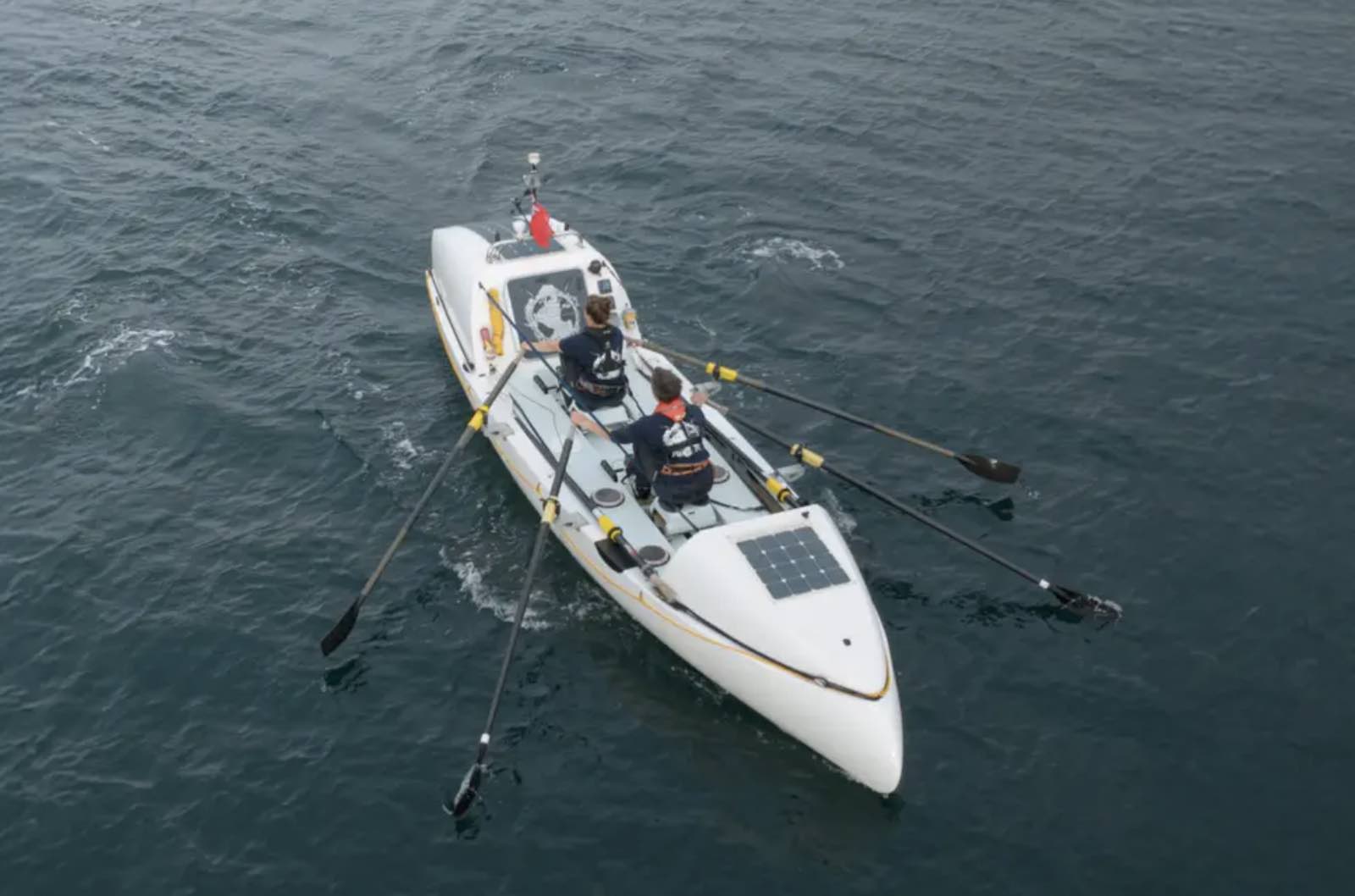
What rowing the Atlantic taught Rosalind Chaston about curiosity, challenge and discovering what you’re capable of.
At our June 2025 Connect Over A Cuppa, we were joined online by Rosalind from Atlantic Escapade for a story that was rather different from our usual business presentations.
I had actually first met Rosalind some time earlier at The Armchair Adventure Festival, where she was raising funds for an ambitious plan to row across the Atlantic with Andy, now her partner.
At that point, the Atlantic crossing was still an ambition. Over the following year I followed their progress as the fundraising and preparation turned into the reality of actually getting onto the water and attempting the crossing. Almost exactly a year later, I was back at the same festival — this time hearing Rosalind and Andy talking about having successfully completed their journey.
There was something rather satisfying about seeing that circle completed, and it was one of the reasons I wanted Rosalind to come and share her story at Connect Over A Cuppa.
But what interested me wasn’t simply the scale of the adventure. It was how she and Andy ended up doing it in the first place.
Rosalind didn’t begin as an experienced ocean rower with a long-held ambition to cross the Atlantic. In fact, her presentation described an earlier version of herself as someone who wasn’t entirely sure what she wanted to do with her life. She had lots of interests, filled her time with activities and was working in a job she didn’t find particularly fulfilling.
Then an opportunity appeared.
Despite not having the skills or experience you might imagine necessary for rowing across an ocean, Rosalind said yes.
Why?
Because it sounded challenging. It sounded interesting. And, perhaps most importantly, she was curious enough to find out where it might lead.
You don’t always need to know where you’re going
Rosalind called her Connect presentation “An Ocean of Change: How Curiosity Drives Clarity.”
I think that title captures something particularly interesting about her story.
We often assume clarity has to come first. Work out exactly what you want. Create a plan. Develop the necessary skills. Remove as much uncertainty as possible. Then act.
Rosalind’s experience suggests another route.
Sometimes action creates clarity.
You try something. You meet different people. You discover what you enjoy and what you’re good at. You find yourself in situations you hadn’t anticipated and learn things about yourself that you couldn’t have discovered by simply thinking about them.
In Rosalind’s case, curiosity ultimately took her onto an ocean.
Most of us probably don’t need to take it quite that far, but the principle still applies.
Saying yes before you feel completely ready
One of the things that stayed with me from Rosalind’s story was her willingness to commit to something despite not having all the obvious qualifications to do it.
There is an important distinction here. This isn’t about ignoring risk or heading into an ocean without preparation.
Once you’ve committed to something significant, you still have to acquire the skills, prepare properly, understand the risks and do the work.
But there is a point before all of that where you have to decide whether you’re willing to pursue the opportunity at all.
And sometimes we rule ourselves out too early.
We tell ourselves we haven’t done it before. We don’t have the right background. Someone else will know more. Perhaps we’ll consider it in a few years when we’re more experienced.
Rosalind’s approach was almost the reverse:
This sounds challenging. I’d like to find out whether I can do it.
Then you start working out how.
Interestingly, it reminded me of another Connect Over A Cuppa conversation we would have much later with Simone Talfourd. Different adventures and different circumstances, but a similar willingness to step towards an opportunity before possessing every skill or knowing exactly where it might lead.
An ocean doesn’t particularly care about your plan
Of course, saying yes is only the beginning.
Ocean rowing brings a rather different level of uncertainty.
You’re dealing with weather, equipment, fatigue, isolation and the physical and psychological challenge of repeating the same demanding activity day after day.
Whatever plan you started with has to coexist with the reality unfolding around you.
That’s one reason I think adventure provides some useful parallels with business and leadership. We like plans because they give us a sense of control, but conditions change.
The objective may remain the same while the route towards it has to adapt.
That requires a different type of confidence: not confidence that everything will go according to plan, but confidence that you’ll be able to respond when it doesn’t.
Challenge reveals things that comfort can hide
Rosalind’s presentation contrasted who she was before this period of her life with who she is now. The earlier Rosalind she described was “kind of floating”, uncertain about what she wanted and assuming that an unfulfilling job might simply be what life was like.
I found that particularly interesting.
We often try to think our way towards answers about what we want from work and life. Sometimes that’s useful.
But challenge gives us information too.
Put yourself into a demanding environment and you quickly discover how you respond to uncertainty, what motivates you, what frustrates you, what you’re capable of learning and which things genuinely matter to you.
You also discover that some of the boundaries you’ve placed around your own capabilities may not be particularly accurate.
That’s relevant in business as well. Someone doesn’t necessarily discover that they’re capable of leading a team by reading about leadership. Sometimes they discover it because circumstances require them to step forward and lead one.
Curiosity is more useful than having everything figured out
Rosalind’s slides deliberately played with the familiar expression that curiosity killed the cat. Her wider message was rather different: curiosity can be a route towards understanding yourself and creating change.
- I think curiosity is one of the most underrated qualities in business.
- Curious people ask questions.
- Why do we do it this way?
- What would happen if we tried something different?
- What could I learn from that person?
- Why does that customer behave like that?
- What might be possible if I stopped assuming I couldn’t do it?
Curiosity doesn’t guarantee that every experiment succeeds. But without it, we can very easily remain inside the boundaries of what we already know.
And eventually those boundaries can become remarkably small.
Adventure and environmental responsibility
Rosalind’s relationship with the ocean also connects with another important part of who she is: her strong interest in the environment.
An Atlantic crossing gives you an unusually direct relationship with the natural world. You’re not observing the ocean from a beach or an aircraft; you’re living on it and responding to it every day.
That connection between adventure and environmental awareness is an interesting one. Experiences in wild places can change how we think about our relationship with them and the responsibility we have for protecting them.
It also adds another dimension to Rosalind’s story. The adventure wasn’t simply about completing an impressive physical challenge. It became part of a much broader process of questioning, learning and working out what mattered to her.
What are you ruling yourself out of?
Perhaps that’s the question I took away from Rosalind’s session.
Most of us aren’t going to row the Atlantic, nor do we need to.
But we probably all have opportunities we’ve dismissed because we don’t quite feel ready.
A business opportunity. A career change. A new role. A qualification. An adventure. A conversation we’ve been meaning to have.
Sometimes the reasons are perfectly sensible.
But occasionally the real reason is simply that we haven’t done it before.
Rosalind’s story challenges that logic.
You don’t always need to possess every skill before deciding that something is worth exploring. You don’t necessarily need complete clarity before taking the first step. And you certainly don’t need to know precisely where an opportunity will eventually lead.
Sometimes curiosity comes first.
Then commitment.
Then the skills.
And somewhere along the way, the clarity starts to appear.
Perhaps we should spend a little less time asking, “Am I ready to do this?” and a little more time asking, “Am I curious enough to find out?”
That, for me, was one of the most useful lessons from Rosalind’s (and Andy’s) Atlantic Escapade.